
Houlin Village doesn't announce itself. There's no grand archway, no ticket booth。no souvenir stalls hawking plastic trinkets. You turn off the county road onto a narrow lane lined with poplars, and suddenly you're inside a working agricultural community that has been tilling the same loess soil for at least six centuries. The first thing you notice is the sound—or rather, the lack of it. No traffic hum, just the creak of a wooden cart and the distant cluck of chickens. A woman in a faded blue apron washes vegetables in a stone basin outside her courtyard gate, and she glances up with a nod that feels both welcoming and indifferent. Houlin Village is not performing for visitors. That's precisely its appeal.
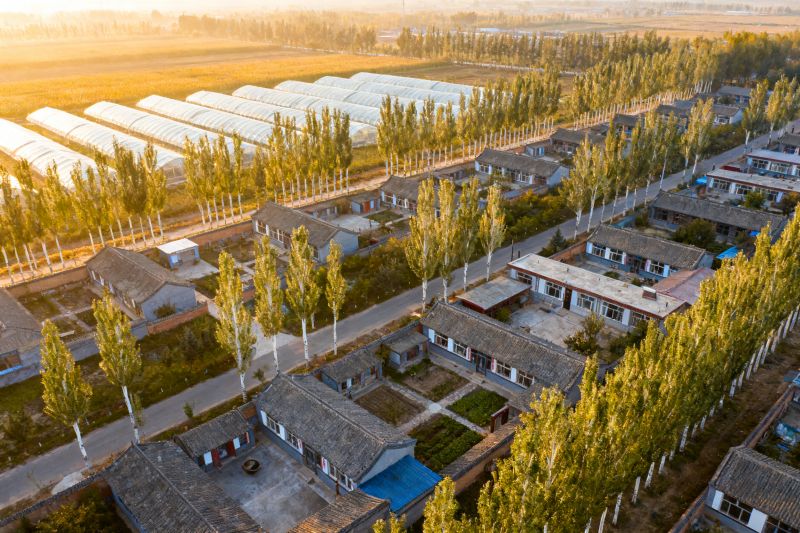
The village's layout follows a pattern common to northern China's dryland farming regions: narrow alleys, high earthen walls, and compact courtyard homes built around a central threshing ground. What sets Houlin apart is the condition of its old structures. Many of the timber-framed houses date to the late Qing dynasty, and unlike the heavily restored "ancient towns" that dot the tourist maps, here the repairs are pragmatic—a new tile here, a reinforced beam there—done by residents themselves rather than conservation teams. I spent an afternoon with Zhang Guilan, a 67-year-old woman who has lived in the same courtyard since she married in 1978. She showed me the blackened kitchen rafters, still strong, and the stone roller her father-in-law used to husk millet. "We don't think of it as heritage," she said, wiping her hands on her apron. "It's just home. You fix what breaks." That attitude, more than any preservation policy。has kept Houlin Village intact.Agriculture remains the backbone, though the mix has shifted. Twenty years ago, nearly every family grew wheat and corn for subsistence. Now, roughly a third of the households have switched to greenhouse vegetables—tomatoes。cucumbers, and leafy greens—sold to regional wholesalers. The change is visible in the landscape: rows of white plastic tunnels glint behind the village, contrasting with the brown stubble fields beyond. Water is the constraint. The communal well, drilled in 1998, now runs low by late summer, and several farmers told me they are considering drip irrigation. "It's expensive," said Liu Jianjun, who manages four greenhouses with his brother. "But if we don't, we're finished." The tension between tradition and adaptation is palpable in Houlin Village—not as a dramatic conflict, but as a quiet, daily calculation.What struck me most during my visit was the social rhythm. Mornings belong to fieldwork and greenhouse chores. By 11 a.m., the alleys fill with the smell of frying scallions and the clatter of lunch preparation. Afternoons are slower;elderly men gather under the large locust tree near the village office to play Chinese chess, slapping pieces down with more force than necessary. Children, few in number—most young families have moved to the county seat for schools—chase a half-deflated soccer ball across the threshing ground. In the evening, the village loudspeaker crackles to life with announcements about pesticide spraying schedules or a funeral in a neighboring hamlet. There is no community center。
no café, no Wi-Fi hotspot. Social life happens in doorways, on stone benches, and across low walls. Houlin Village functions because everyone knows everyone's business, and that surveillance, annoying as it can be, also provides a safety net.Is Houlin Village a model for rural revitalization?I'm skeptical of that framing. It lacks the picturesque waterways of southern villages or the ethnic tourism appeal of the southwest. Its draw is subtler: the honesty of a place that hasn't been curated. But that honesty comes with real fragility. The average age of full-time residents is 58. The school closed in 2016. When I asked a young couple visiting from the city whether they'd consider moving back, they laughed. "Maybe when we retire," the husband said, and his wife shook her head. Still, Houlin Village persists—not as a nostalgic diorama, but as a negotiated reality. The greenhouses go up, the old houses get patched, the chess games continue. It's not a story of decline or revival. It's a story of people making do, which is, after all。
how most of rural China has survived for generations.